3D Scanning: Two Technologies Compared
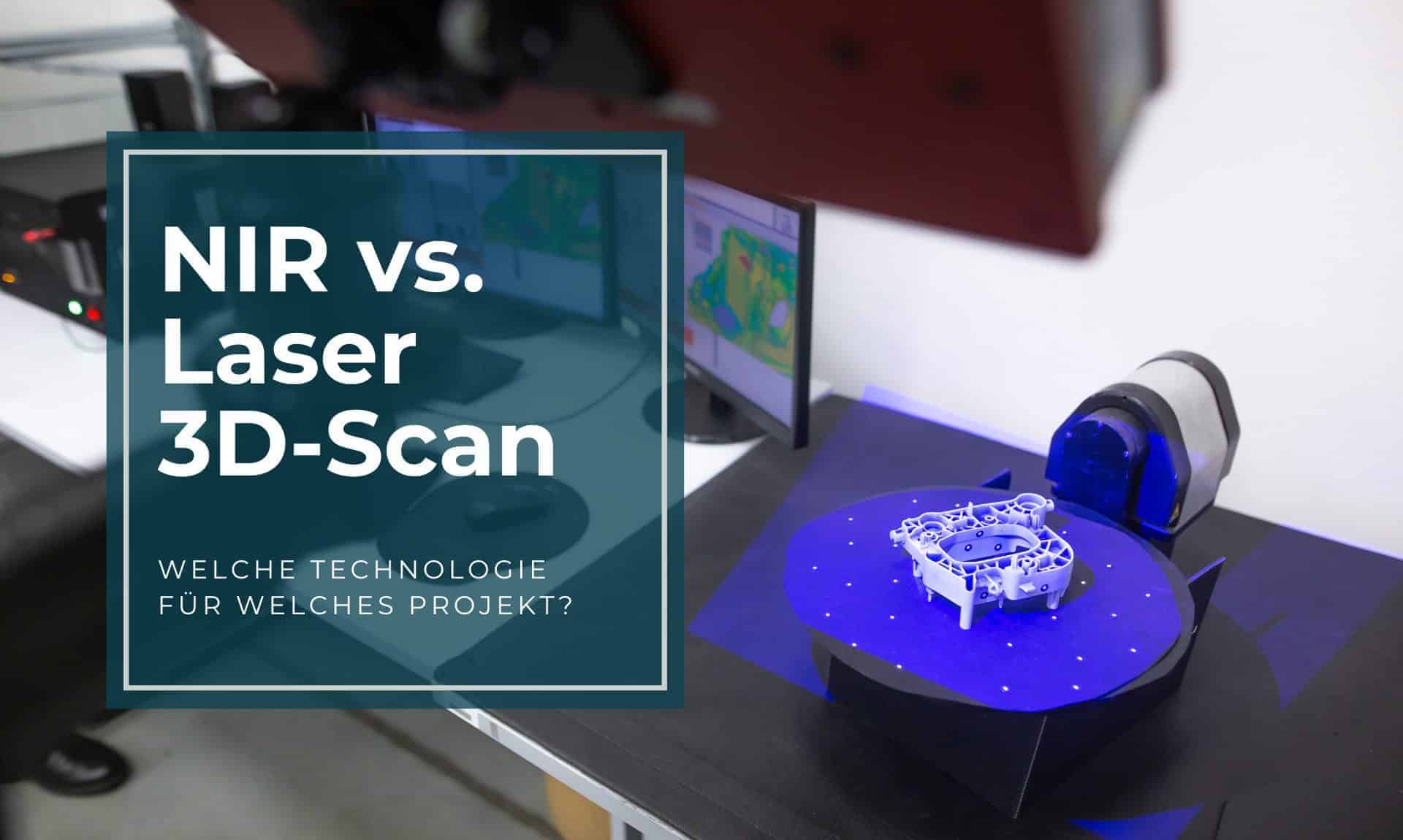
In professional 3D digitization, two methods play a central role: NIR scanning (Near-Infrared) and Laser scanning. Both produce highly precise point clouds but differ fundamentally in how they work, their accuracy, and their ideal applications.
NIR Scanning — Gentle and Versatile
NIR scanning uses infrared light in the wavelength range of 760 to 2,500 nm. The light is reflected off the object surface and captured by sensors.
Technical Characteristics
- Accuracy: Up to 0.05 mm
- Wavelength: 760–2,500 nm (near-infrared)
- Non-contact: No physical contact with the object
- Scan speed: High, especially for surface capture
Ideal Applications
- Transparent or semi-transparent materials (glass, plastics)
- Highly glossy and reflective surfaces (polished metals)
- Delicate objects that cannot be touched
- Detailed surface texture analysis
Laser Scanning — Precise and Industrial-Grade
Laser scanners emit a focused laser beam that traces the surface. The exact distance is calculated via triangulation or time-of-flight measurement.
Technical Characteristics
- Accuracy: Up to 0.02 mm
- Measurement principle: Triangulation or time-of-flight
- Range: From a few centimeters to several meters
- Data quality: Extremely dense point clouds
Ideal Applications
- Opaque, solid materials (metal, wood, plastic)
- Complex geometries with undercuts
- Quality control and nominal-actual comparison
- Large-volume components and structures
Direct Comparison
| Criterion | NIR Scanning | Laser Scanning |
|---|---|---|
| Accuracy | Up to 0.05 mm | Up to 0.02 mm |
| Best materials | Transparent, glossy | Opaque, solid |
| Cost | More affordable | Higher investment |
| Data volume | Medium | Very high |
| Post-processing | Low | Medium to high |
Practical Examples
Spare parts reproduction: A worn gear is digitized via laser scan and reconstructed as an exact CAD model — accuracy below 0.05 mm.
Reverse engineering: An existing housing made of glossy plastic can be captured gently with NIR, without surface preparation.
Wear analysis: Injection molds are repeatedly scanned to detect material wear early and optimize tool life.
Trade show models: Architectural models are converted into scalable 3D data via laser scan — as a basis for enlarged or miniaturized exhibition pieces.
Our Recommendation
The choice of technology depends on the material, desired accuracy, and project scope. For reflective or delicate surfaces, we recommend NIR. For maximum precision on solid components, laser scanning is the best choice. In many cases, a combination of both methods delivers optimal results.